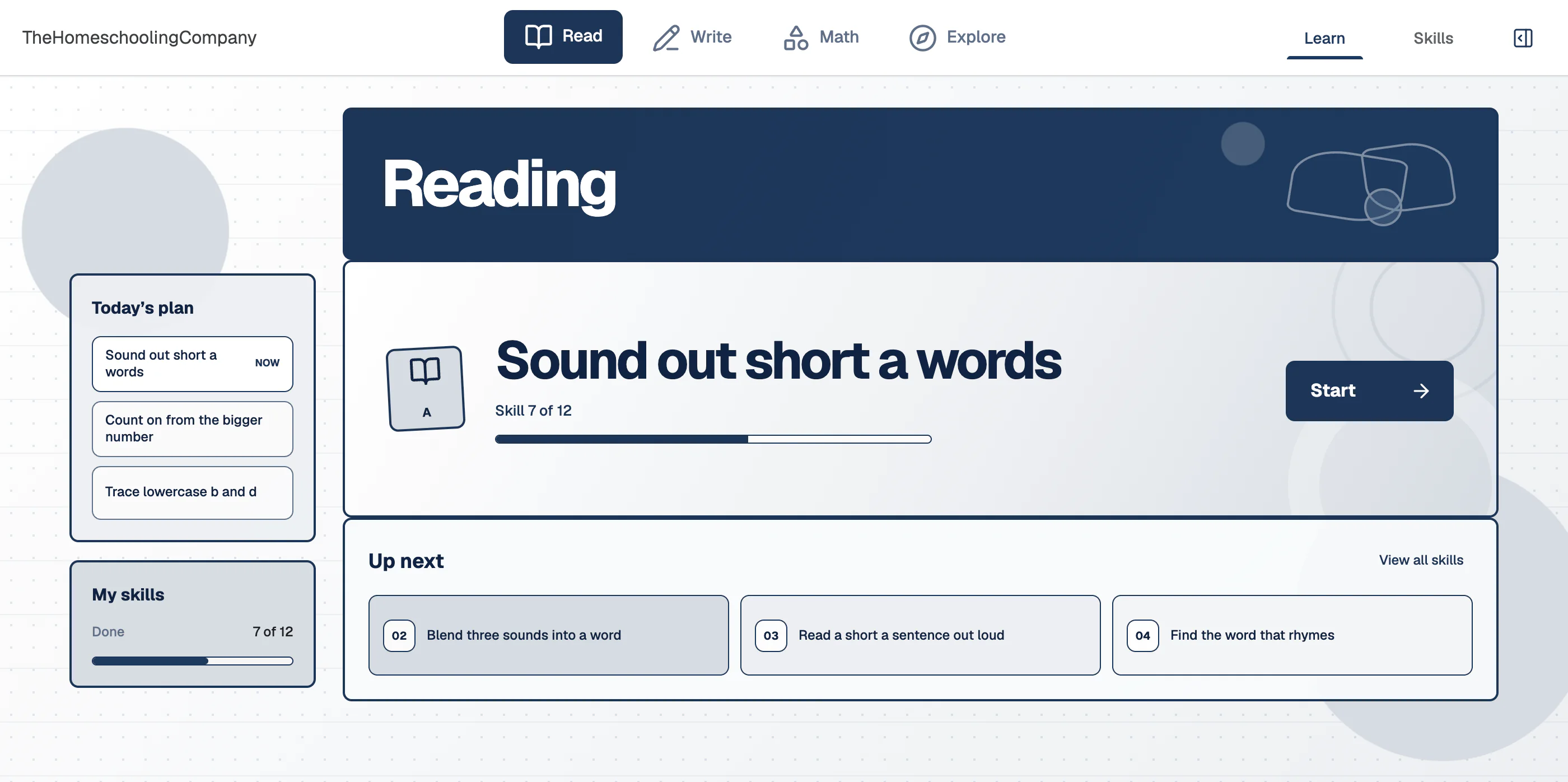
K–2 lessons built around your child.
Lessons use the things your child loves. Instructions are read aloud, and your child answers by voice or tap, with an adult nearby.
Kindergarten through 12th grade. We find where your child is in every subject and write each lesson for them.
Lessons use the things your child loves. Instructions are read aloud, and your child answers by voice or tap, with an adult nearby.
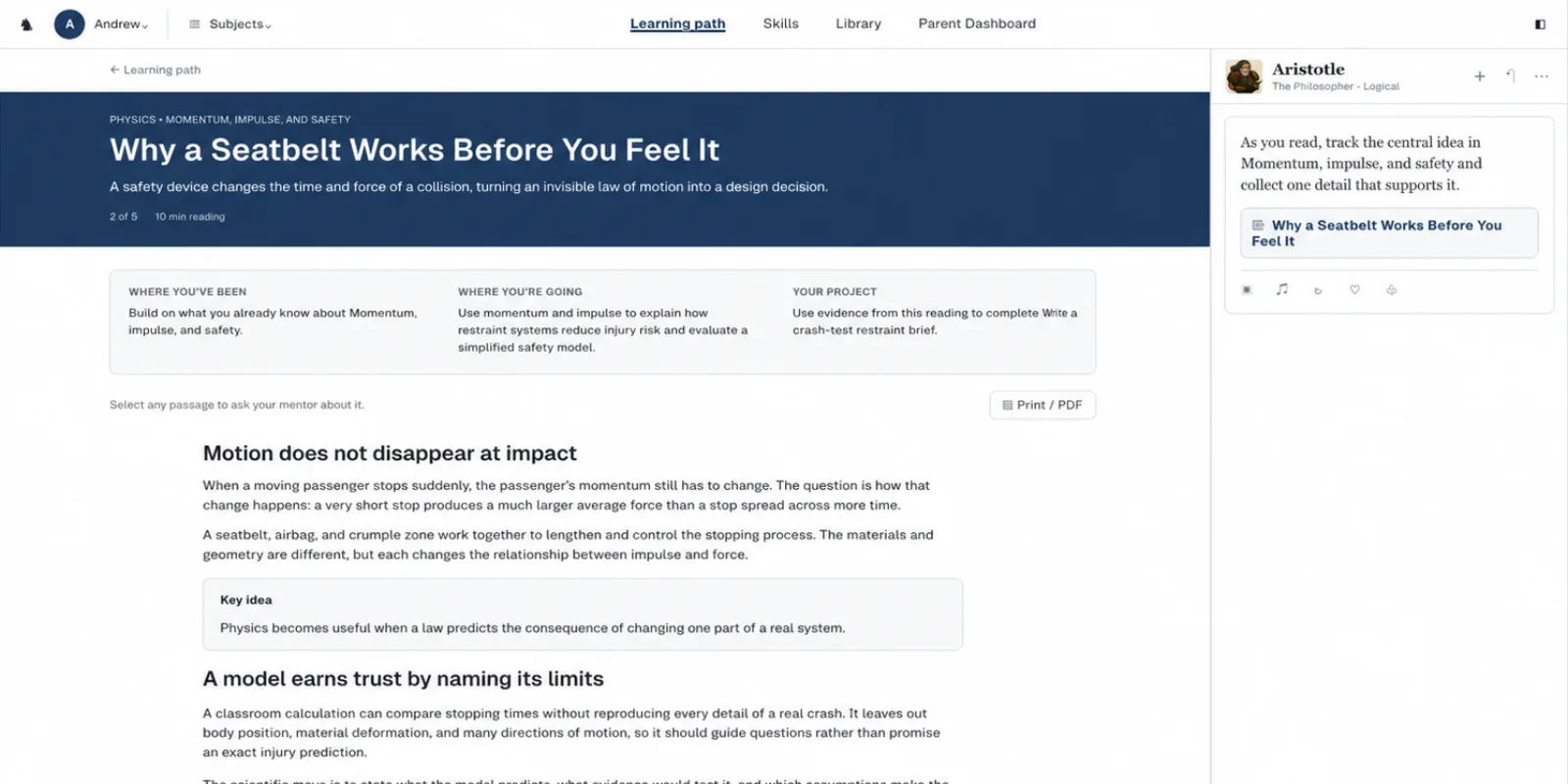
In the physics lesson shown here, your child reads how seatbelts change the force of a collision, completes quick checks, and uses the evidence in a crash-test safety brief. We grade the checks and project immediately, with feedback to help them revise.
39 courses for grades 3 to 12, and 40 AP exam prep courses for high school.
Build number sense, work with shapes and data, and strengthen the skills your child needs for algebra.
Solve equations, graph relationships, and explain each step.
Draw and measure shapes, calculate area and volume, and explain each step in a geometric proof.
Use limits, derivatives, and integrals to explain rates of change and accumulated quantities.
Compare samples, calculate probability, and decide which conclusions the data support.
Build scientific thinking through evidence, models, investigation, explanation, and a clear path into specialized science courses.
Use forces, motion, and energy to make predictions and explain what observations show.
Explain how particles interact, balance reactions, and calculate the quantities a reaction needs.
Trace how cells, heredity, and ecosystems work, then use evidence to explain changes in living systems.
Study planets, stars, and galaxies through observations, scale models, and space imagery.
Read maps and weather data, explain Earth’s changing systems, and distinguish evidence from a prediction.
Study how atomic structure affects a material's strength and behavior, then test which materials suit an engineering problem.
Write, test, and debug programs, then explain the algorithms behind them.
Your student learns to get far more done with AI: learn faster, research and write with sources, build working tools, and automate the busywork, while checking every result.
Read circuit diagrams, calculate electrical quantities, and reason through why a circuit works or fails.
Learn the engineering behind machines by designing, analyzing, testing, and improving systems that have to work.
Your child learns how real things get made, then designs a process that can make them reliably, affordably, and at scale. Grades 6-12.
Read closely, support an interpretation with evidence, and revise writing for meaning and clarity.
Compare primary sources, trace causes and consequences, and defend a historical argument with evidence.
Read and make maps, compare regions, and explain how people and environments shape one another.
Trace how a public decision gets made, apply constitutional rights to a case, and explain how citizens can respond.
Compare political institutions, examine policy arguments, and explain how public decisions get made.
Examine how psychological studies test a claim, interpret their results, and consider other explanations.
State a claim clearly, test its assumptions, and answer the strongest objection to it.
Compare cultural traditions and accounts from different perspectives, then use evidence to question your first interpretation.
Test a business idea against customer needs, estimate costs, and revise the plan when the evidence changes.
Use supply, demand, and incentives to explain choices and weigh the effects of an economic policy.
Build a budget, calculate compound interest, and compare the costs and risks of financial choices.
Develop an artwork, make deliberate choices about technique and composition, and revise it after feedback.
Build a clear argument, adapt it for an audience, and revise a speech or media project after feedback.
Check health claims, work through safety scenarios, and learn when to ask a trusted adult or qualified professional.
Apply biology to medical case studies, examine evidence, and explore how healthcare professionals make decisions.
Study movement, training, and recovery, then explain the choices in a fitness plan.
Daily SAT practice, targeted review, and explanations that turn weak spots into a plan.
Adaptive ACT practice for English, Math, Reading, optional Science, and optional Writing.
Read a legal case, identify the rule that applies, and build an argument that addresses both sides.
Draw a scaled space plan, weigh structural and environmental constraints, and revise the design.
Roman military engineering, marine conservation, the history of chess: your child can turn an interest beyond the catalog into a custom elective.
We start it at their level, with real units, lessons, and projects, and grade it like everything else they study.

Choose a thinker for your child to learn beside. Our mentor answers questions about the reading, draws explanations on its board, and offers help when your child seems stuck. During independent checks, it guides their thinking without giving away answers.
$49/month
$149/month per child
Contact us
Family pricing for School in a Box is automatic: $125 per child for two children, $100 for three, $85 for four, and $75 for five or more. A child counts once their first paid month begins.
We're an approved ESA vendor in Arizona, Alabama, New Hampshire, and Utah. You can request payment through ClassWallet or Odyssey, subject to your program’s approved-expense rules.
Choose the subjects they need and the interests they want to explore. We turn that starting point into their next lesson.
$149/month per child after the trial.